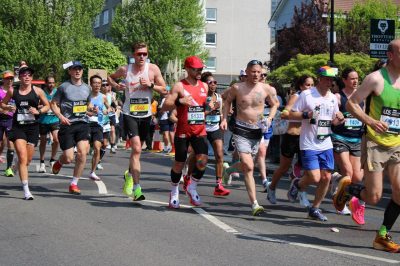


I get asked this question more than almost any other. Usually by a runner somewhere in their mid-forties, who’s hit a plateau, watched their race times drift in the wrong direction over the last year or two, and is starting to wonder whether the best running years are quietly behind them.
I understand the worry. I’ve been there myself, and I’ve coached hundreds of runners through it. So let me give you the honest answer, not the polite one.
Yes. You can genuinely get faster at 45. Not by training the way you trained at 25, but by training in a way that matches the runner you actually are now. The 45-year-old runner has advantages that the 25-year-old version of you never had. The trick is knowing what they are and how to use them.
In this article, we answer the question: Can a 45-year-old runner genuinely get faster? This is what I tell every midlife runner who walks through my door with that question.
I won the London Marathon in 1983 in 2 hours 9 minutes. I trained with Steve Ovett. I’ve been coaching runners since the early eighties, and I’ve watched the same patterns play out, over and over again, in runners from every walk of life.
Here’s what I’ve seen. Most 45-year-old runners who come to me thinking they’re past it can take meaningful time off their personal bests in the first 12 months of working together. Some of them set lifetime bests in their late forties. A few set lifetime bests in their fifties.
This isn’t because I have a magic plan. It’s because most of these runners had been training in a way that no longer fitted the body they were running in. Once we changed that, the times started moving again.
So the real question isn’t whether you can get faster at 45. The question is whether you’re prepared to change how you train.
You deserve the truth, so let me give it to you.
Your aerobic capacity, measured as VO2 max, declines roughly 1% per year after the age of 35 if you do nothing about it. The phrase that matters there is “if you do nothing about it”. In trained masters runners who keep at it, that decline is far slower, sometimes barely measurable over five or ten years (Tanaka and Seals, 2008, Journal of Physiology, on cardiovascular ageing in masters athletes).
Recovery genuinely does slow down. A hard session at 45 takes longer to bounce back from than the same session at 25, and ignoring that is one of the fastest routes to injury in this sport.
Muscle mass becomes something you actively defend, not something you can take for granted. The body becomes less efficient at building and repairing tissue, which is the real reason strength training stops being optional after 40.
What doesn’t decline meaningfully at 45 is your running economy, your race-day judgement, and your psychological resilience. If anything, those three things improve with experience. They’re worth more in a marathon than another few percentage points of VO2 max ever was.
Here’s the hard truth I’ve delivered to hundreds of runners over the years, and it’s never the answer they expect.
You haven’t plateaued because you’re 45. You’ve plateaued because you’re still training the way you trained at 30. Same paces, same sessions, same weekly structure, same recovery habits. The body has changed. The training hasn’t.
This is the single most common pattern I see. A runner who used to set PBs every year suddenly stops, blames their age, and works harder to compensate. Harder is rarely the answer. Smarter almost always is.
I covered exactly this pattern in a previous Ask the Coach response about a runner who missed their London Marathon goal. The diagnosis was the same: a runner doing what had always worked, expecting a result that no longer came.
If you take nothing else from this article, take these five things. They’re what I work on with almost every masters runner who comes to me.
1 – Slow your easy runs down. Properly. Not slightly. Not a bit. Genuinely slow. If you can’t hold a conversation, you’re going too fast. Most midlife runners I work with discover their “easy” pace was actually their moderate pace, and that quiet error was costing them every hard session in the week. Our Heart rate zone calculator is a useful sanity check if effort is hard to judge by feel alone.
2 – Add strength training. Two short sessions a week are enough. Squats, deadlifts, single-leg work, and core. You don’t need to look like a gym regular. You need to defend the muscle mass and the stride power that your running depends on. This is not optional after 40. It’s training.
3 – Treat recovery as a session in itself. Sleep is training. Protein at every meal is training. An easy day, actually run easy is training. Our Running nutrition for midlife runners guide covers the fuelling side properly.
4 – Quality over quantity in your hard sessions. One properly executed threshold session a week beats three half-hearted ones. The 45-year-old body adapts well to quality work, but it doesn’t adapt to junk mileage at a moderate pace. Pick the right sessions, do them well, and protect the days around them.
5 – Build your year around one A-race. Not three. One. The runners who keep improving past 45 are the ones who treat the year as a single, focused training block aimed at one start line. We covered this in detail in our piece on How much you can realistically improve your marathon time in 12 months, and it applies double once you’re a masters runner.

I want you to sit with this for a moment, because most midlife runners never do.
The 25-year-old version of you ran hard, but ran stupid. You didn’t sleep enough. You didn’t strength train. You raced too often. You ate poorly when you could get away with it. You ignored niggles until they became injuries. You chased PBs at every event and wondered why your big race didn’t come together.
The 45-year-old version of you doesn’t have any of those problems…
You have patience.
You have consistency.
You have the discipline to actually follow a plan when nobody’s checking.
You’re better at delayed gratification, which is the entire psychological game of marathon training.
In my experience, those qualities matter more in marathon improvement than youthful recovery does. I’ve seen it in client after client. The runner who takes the long view, follows the plan, and trusts the process almost always finishes ahead of the one with more raw talent but less patience.
Your best run, in other words, may genuinely still be ahead of you. Not despite your age. Because of what your age has taught you.
I coached one runner from 3:25 down to 3:02 over the course of about 18 months, and he’s now within touching distance of breaking three hours. He came to me in his late forties, convinced he was finished.
I coached another from 2:38 to 2:27. He’d been stuck at 2:38 for years. Same pattern. Same diagnosis. Same approach.
I’ve watched runners in their late forties and early fifties set personal bests they thought they’d left behind ten years ago. None of them had unusual genetics. What they had was a willingness to train differently and a coach holding them accountable to that.
You can see the full set of results on our Run Your Best Race coaching page if you want to see the names and the numbers.
I don’t want you to close this article feeling motivated and then change nothing. Motivation fades. Habits don’t.
Here are three specific things to do this week.
Run your next easy run a full minute per mile slower than you usually would, and see how you feel the next morning. If you wake up genuinely fresh instead of slightly tired, that’s the pace you’ve been missing.
Book two short strength sessions into your diary for next week, and the week after, and the one after that. Twenty minutes each is fine. Just get them in.
Pick your A-race for the next 12 months. One race. Write it down somewhere you’ll see it. Then start thinking about your year as one training block aimed at that single start line, not as a calendar of events to chase.
That’s where it starts.
Getting faster at 45 isn’t a young person’s project anymore. It’s a patient runner’s project. And that, after everything you’ve learned, is exactly what you’ve become.
Trust the runner you are now. Train for the body you have, not the one you had at 25. The improvement is there for the taking. I’ve watched it happen too many times to doubt it.
Your best run, I promise you, is still ahead.
Join our mailing list to stay up to date with the latest UK running events, training tips, and exclusive offers on running products. Rest assured, we value your privacy and would never dream of selling your address. Sign up now…